


Abstract
The future of SEO is evolving rapidly with advancements in artificial intelligence, Google algorithms updates, and new integrations like Google & Reddit partnership and Google Gemini results. This blog explores findings from a survey conducted with digital marketers, SEO consultants, and agency owners to uncover insights into the future of SEO and how these changes are reshaping strategies. Key insights include the rising importance of AI optimization, the focus on Google’s E-E-A-T standards, and adapting content for hybrid AI and traditional search elements. Respondents highlighted challenges like balancing human-centric and AI-friendly content, understanding algorithms, and maintaining high-quality standards amidst rapid technological shifts. By embracing AI tools, refining technical SEO, and prioritizing user intent, businesses can navigate this transformative era of search and maintain a competitive edge.
Introduction
SEO is changing fast, with artificial intelligence and new Google updates leading the way. SearchGPT and Gemini results are transforming how search works. Partnerships like Google’s collaboration with Reddit add even more complexity to this evolving field.
Google’s core updates, including the Helpful Content update, emphasize high-quality, user-focused content. These shifts are forcing marketers and SEO professionals to adapt quickly to the changing future of SEO. The question is, how can businesses adjust to stay visible in search results?
To answer this, we surveyed digital marketers, SEO consultants, and agency owners. Our goal was to understand their perspectives on these changes. This blog will explore the survey findings, including how experts are adapting to AI search results and recent algorithm updates. Let’s explore what the future of SEO might hold and how you can prepare.
Key Survey Findings
Our survey revealed important insights about how SEO professionals view the future of search. From AI-driven results to Google’s recent updates, here are the main takeaways shaping the future of SEO:
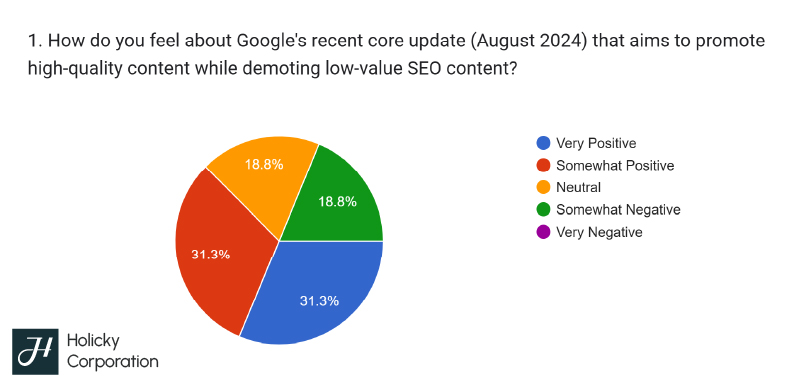
1. Mixed Reactions to Google’s Core Updates
- Positive Feedback: Most respondents felt optimistic about Google’s focus on high-quality content. Over 60% rated the changes as positive.
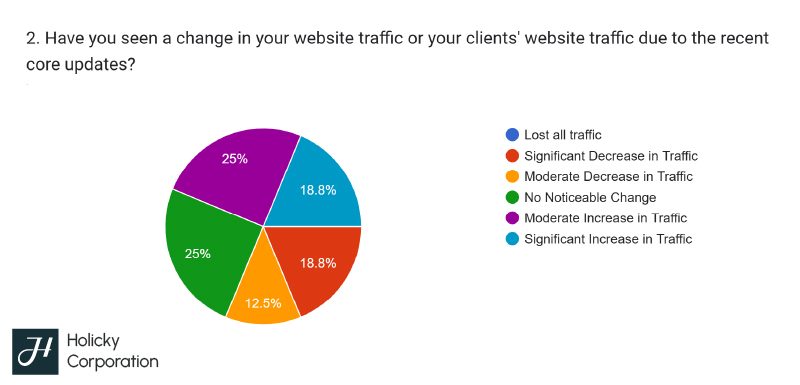
- Traffic Changes: Traffic trends varied widely. About 25% reported significant or moderate increases, while others saw decreases or no changes.
2. AI and SearchGPT Are Reshaping the future of SEO
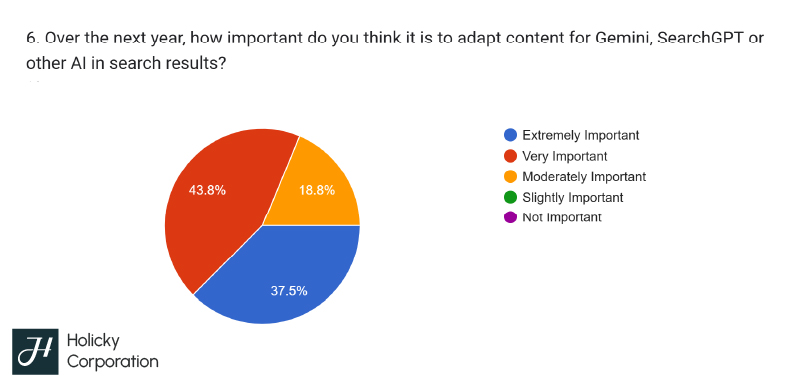
- Adaptation is Crucial: Over 80% of respondents said adapting content for AI, including SearchGPT and Gemini, is very or extremely important. This mirrors broader industry trends, where Goodfirms recent research showed that 55% of marketers have completely adopted LLMs for their marketing activities.
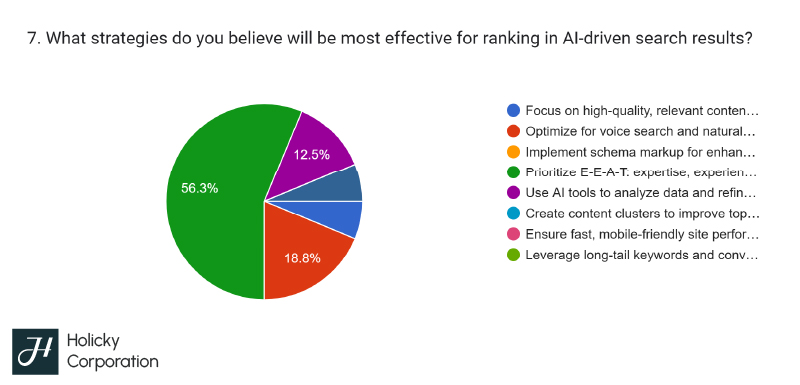
- Strategies for AI Search: Many are prioritizing expertise, authority, and relevance (E-E-A-T) to rank in AI-driven results.
3. Content Strategy Shifts with Reddit Partnerships
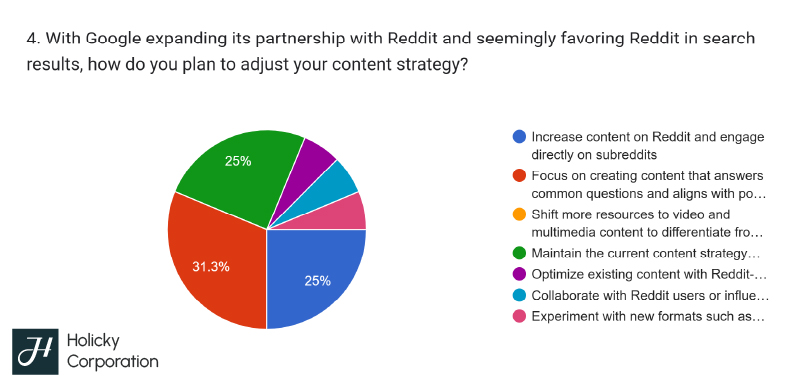
Google’s partnership with Reddit has encouraged some to rethink their content strategies. Nearly half of respondents plan to engage more with user-generated platforms. Others are monitoring trends while maintaining their current approach.
4. Challenges in AI Optimization
The biggest hurdles include understanding AI algorithms and balancing content for both human readers and AI systems. Rapidly changing technology was a major concern for many.
5. Future Predictions
Participants shared their predictions for the next phase of SEO:
- Greater emphasis on search intent and user behavior.
- Long-tail keywords gaining more importance.
- Increased focus on AI summaries and multimedia content.
These findings show that SEO professionals are actively adjusting their strategies. Adapting to these changes is no longer optional—it’s essential for success in today’s competitive digital landscape.
Expert Perspectives on AI and SearchGPT
The rise of AI-driven search, led by SearchGPT, is significantly influencing the future of SEO and how professionals approach their strategies. Survey participants shared a range of insights on the impact of these tools and how they are adapting.
1. Shifts in Strategy
Many respondents highlighted the need to prioritize content designed for AI-driven results. Strategies such as conversational keywords, structured data, and multimedia content are becoming more important. Over 70% of participants mentioned they are actively revising their content to align with AI preferences.
2. E-E-A-T Takes Center Stage
Several experts emphasized the importance of Google’s E-E-A-T (Expertise, Experience, Authority, Trustworthiness) guidelines. Content that showcases in-depth knowledge and real-world experience is seen as a cornerstone for success in AI-powered search.
3. Focus on User Intent
Participants pointed out that AI tools are increasingly prioritizing user intent. Creating content that directly answers user questions or solves problems is essential. Marketers noted that tailoring content to these needs improves both user satisfaction and search rankings.
4. Opportunities with AI
While challenges exist, respondents also saw opportunities. AI systems like SearchGPT can help businesses gain visibility by surfacing high-quality, well-structured content. Some respondents plan to leverage AI to generate ideas and optimize content for emerging search trends.
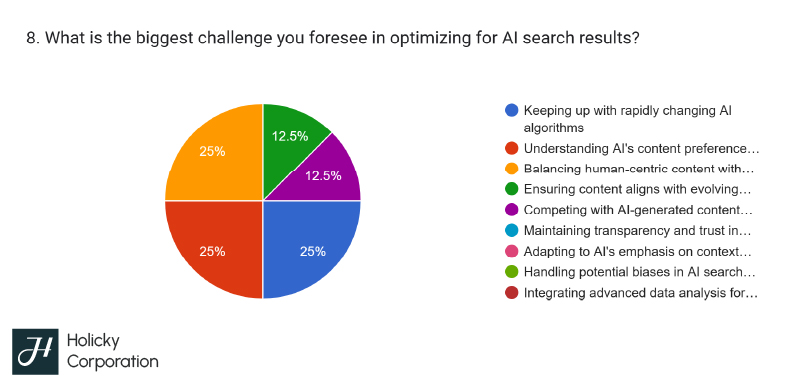
The overarching message from respondents is clear: adapting to AI-driven search is critical. Those who embrace these changes early will have a significant advantage in the competitive SEO landscape.
Adapting to Google’s Algorithm Updates
 Google’s recent core updates, including the Helpful Content and spam updates, continue to push SEO toward prioritizing value and user experience. Our survey revealed how industry professionals are responding to these changes and adapting their strategies.
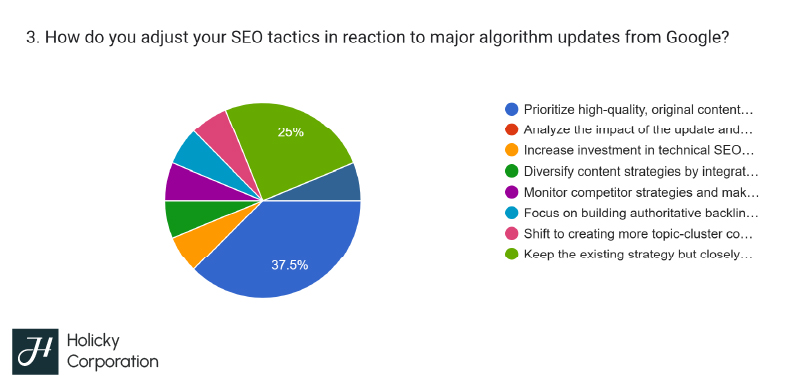
1. Prioritizing High-Quality Content
A majority of respondents emphasized the importance of creating high-quality, user-focused content. They are moving away from keyword-stuffed pages and focusing on content that directly meets user needs. This shift aligns with Google’s Helpful Content update, which favors valuable, in-depth information over shallow or automated content.
2. Regular Monitoring and Adjustments
Many participants shared that they monitor algorithm updates closely to assess their impact on rankings and traffic. Regular content audits and performance reviews have become common practices. These allow marketers to identify areas of improvement and adjust strategies promptly.
3. Focusing on User Intent
Understanding user intent is now a critical part of SEO. Professionals reported tailoring their content to answer specific questions or solve common problems their audiences face. This approach not only aligns with Google’s preferences but also improves engagement and trust.
4. Strengthening Technical SEO
Several experts highlighted the importance of technical SEO in light of algorithm changes. Fast-loading websites, mobile optimization, and clear site structures help ensure content is accessible and ranks higher. These elements are especially vital as AI systems like SearchGPT evaluate websites for technical quality.
5. Building Authority and Trust
With spammy practices being penalized, establishing authority is more critical than ever. Respondents shared that they are investing in strategies like earning backlinks from reputable sources and highlighting author expertise to boost credibility.
By focusing on quality, relevance, and technical excellence, SEO professionals are preparing for a resilient future of SEO shaped by ongoing algorithm updates. These strategies not only help maintain rankings but also build long-term value for users and search engines alike.
The Role of Gemini Results in SEO
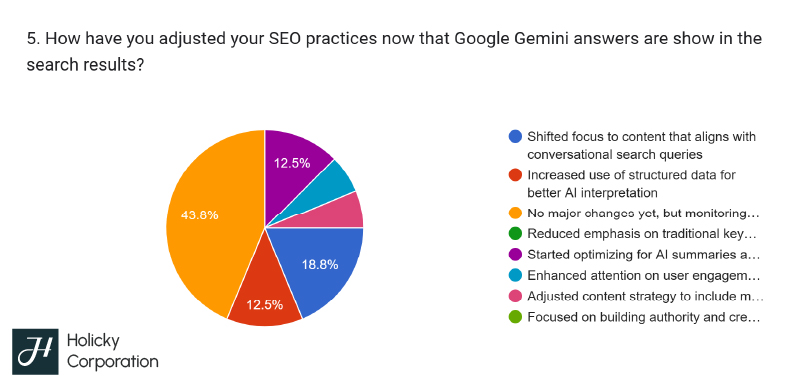
Google’s Gemini results are shaping a new era of search, combining AI-driven answers with traditional search elements. This hybrid approach is pushing SEO professionals to rethink how they structure and optimize their content. Our survey uncovered several trends and strategies regarding Gemini’s impact on SEO.
1. Adapting Content for AI Summaries
Many respondents noted the importance of aligning content with AI-driven summaries, which Gemini incorporates directly into search results. Structured data, concise summaries, and clear headers were among the top strategies mentioned for achieving visibility in these AI-generated previews.
2. Optimizing for Featured Snippets
Gemini builds on existing features like featured snippets by delivering richer, more conversational responses. Participants emphasized the need to tailor content for these snippets by addressing common user questions and incorporating conversational language. This aligns content more closely with the way Gemini processes information.
3. Focus on Relevance and Context
Survey participants highlighted that relevance and context are becoming more important than ever. Gemini prioritizes content that not only answers a query but also provides broader context. Many professionals are revisiting their content strategies to ensure every piece delivers comprehensive value.
4. Balancing Long-Form and Concise Content
Some respondents shared that they are experimenting with a mix of content lengths to cater to Gemini’s dual focus on summaries and in-depth answers. Creating detailed articles with easily digestible sections allows their content to perform well in both AI summaries and traditional search rankings.
5. Tracking and Adjusting Based on Performance
As Gemini evolves, respondents are monitoring traffic and rankings to gauge its impact. Regular analysis helps them identify which strategies are working and refine their approach as Google continues to enhance this feature.
The rise of Gemini results presents both challenges and opportunities for SEO professionals. By focusing on AI-friendly content structures and prioritizing relevance, businesses can position themselves to succeed in this new search landscape.
Reddit’s Growing Role in Search
 Google’s partnership with Reddit is introducing a new dimension to search rankings. By favoring user-generated content, Google is signaling a shift toward more authentic and community-driven results. Our survey explored how SEO professionals are adapting to this trend.
1. Incorporating Reddit in Content Strategies
Nearly half of the respondents plan to increase their engagement with Reddit as part of their SEO strategies. This includes creating Reddit accounts to participate in relevant discussions and sharing content that adds value to specific communities.
2. Focusing on User-Generated Content
With Reddit results gaining prominence, SEO professionals are looking to create content that mimics the authenticity of user discussions. Some respondents shared plans to encourage user reviews, testimonials, and FAQs to match the type of content Reddit excels in showcasing.
3. Monitoring Trends in Reddit Communities
Many participants emphasized the importance of monitoring Reddit threads to identify trending topics and questions. These insights can inspire blog posts, FAQs, or guides tailored to what users are actively searching for and discussing.
4. Building Authority in Niche Subreddits
Some respondents mentioned that establishing authority in niche subreddits can drive both traffic and backlinks. Engaging in meaningful ways within these communities allows businesses to become trusted sources, which can lead to better visibility in search results.
5. Balancing Reddit Integration with Existing Strategies
While Reddit offers new opportunities, respondents were cautious about over-relying on it. They plan to use it as a supplement to traditional SEO tactics, ensuring a diverse strategy that isn’t overly dependent on one platform.
Reddit’s growing role in search provides a chance for businesses to connect with audiences on a more personal level. By embracing user-generated content and engaging with Reddit communities, marketers can align with Google’s evolving preferences while building trust with their audience.
Changes in Website Traffic Post-Updates
 Google’s recent core updates, including the Helpful Content and spam updates, have created mixed outcomes for website traffic. Our survey revealed a range of experiences among SEO professionals regarding how these updates impacted their own websites and their clients’.
1. Traffic Increases for Some
About 25% of respondents reported a significant or moderate increase in website traffic following the updates. These professionals credited the rise to their focus on producing high-quality, user-focused content that aligns with Google’s Helpful Content guidelines. For these businesses, the updates reinforced the value of creating valuable, relevant information.
2. Neutral Impact for Others
An equal proportion of participants (25%) reported no noticeable change in traffic. These professionals suggested that their existing strategies, such as regular content audits and technical SEO improvements, helped them maintain stability during the updates. This highlights the importance of consistently adhering to best practices in SEO.
3. Challenges for Some Websites
Unfortunately, not all respondents fared well. About 30% experienced significant or moderate traffic decreases. Many attributed this to shifts in Google’s algorithm that deprioritized older, less updated content. Some also noted difficulty in adapting quickly to new guidelines, such as increased emphasis on user intent and spam filtering.
4. Key Takeaways
Participants shared several insights for navigating these changes:
- Regularly update older content to keep it relevant and engaging.
- Prioritize website performance and technical SEO to avoid penalties.
- Use data analysis to pinpoint areas needing improvement post-update.
Google’s updates continue to reward sites that provide value while penalizing low-quality practices. By focusing on quality and relevance, businesses can mitigate risks and capitalize on opportunities created by algorithm changes.
Preparing for the AI-Driven Future of SEO
 As artificial intelligence becomes central to search, SEO professionals are rethinking their strategies to stay ahead. Our survey highlighted key ways experts are preparing for this AI-driven future, from adapting content to enhancing technical skills.
1. Optimizing for AI Search Engines
Respondents emphasized the importance of tailoring content for AI tools like SearchGPT and Google Gemini. Strategies include focusing on conversational keywords, clear content structures, and multimedia elements. These adjustments ensure content is accessible and relevant to both AI algorithms and human users.
2. Prioritizing E-E-A-T Standards
Expertise, Experience, Authority, and Trustworthiness (E-E-A-T) are more important than ever. Many professionals shared plans to refine their content by showcasing author expertise, using credible sources, and improving transparency. These efforts help build trust with users and AI systems alike.
3. Enhancing Technical SEO
Technical SEO plays a critical role in AI-driven search. Survey participants highlighted fast page load times, mobile optimization, and schema markup as priorities. These elements ensure websites are easily navigable by AI tools and rank higher in search results.
4. Investing in AI-Driven Tools
Many respondents are exploring AI tools to optimize their SEO efforts. These include AI-driven content generators, keyword research platforms, and analytics tools. By leveraging AI themselves, professionals can stay competitive and create content that aligns with AI preferences.
5. Balancing AI and Human-Centric Content
Creating content that appeals to both AI algorithms and human readers is a recurring theme. Respondents emphasized the need to maintain a human touch while ensuring content is technically optimized. This balance helps businesses engage audiences while meeting AI-driven requirements.
When asked “How do you plan to balance creating content that appeals to both human readers and AI algorithms?” here is how the participants responded.
“The goal of humans and AI both is to have highly relevant and engaging content that solves a users problem. That is what we will focus on and it will align well with both. This is true of SEO as well.” -Josiah Bussing, Mountaintop Web Design
“Google became very good at determining the difference between human and spam content. I don’t believe targeting AI will be the best solution. 100% focussing on human readers will be our approach and depending on AI to interpret that well, after all this will align with Google’s goal for AI to read like a human reads.” -Justin N., SEO Expert Gold Coast
“It’s a matter of creating content that users will engage with. That is the first priority.” -Andres Aguero, Strategy Interactive
“Create for humans and then test with AI” -Nathan Quinn, Quinn Marketing
“Structure, technical SEO and answer to search intent” -Arthur Cotton, Cassiopea Services Inc.
“We will always create content for humans because humans are the end decision maker. Until that changes our content should align towards human engagement.” -Robb Fahrion, Flying V Group
“SEO, in my mind is just a checklist. Tools like SEO editors do a good job to give you that checklist. You want to create the content for humans and check stuff on the SEO checklist that make sense for humans too:
– a title that draws attention with numbers, value for the user (these are good for people too)
– focus on a topic, don’t be all over the place (this is good for people too)
– content variety: text, images, videos that explain the concept – this is good for people tooSo, it is content for people with a mindful attitude towards SEO optimization.” -Andrei Blaj, Atta Systems
“Balancing content for human readers and AI algorithms involves focusing on value, relevance, and readability while adhering to SEO best practices. I’ll prioritize engaging, well-researched information that genuinely benefits readers, making it concise and actionable to improve user experience. Structuring content with headers, bullet points, and clear sections ensures both readability and algorithmic clarity. Leveraging data insights from AI tools, I’ll refine keyword use and intent-matching, aiming to answer common questions thoroughly. Maintaining a natural, conversational tone helps with voice search, while using schema markup and metadata allows algorithms to better understand and rank content effectively.” -Rahul Singh, Promatics Technologies
“By blending engaging, informative content with strategic keyword placement and technical SEO, ensuring it resonates with readers while being optimized for search engines.” -Sanjay Ghinaiya, World Web Technology Pvt. Ltd.
“1. Prioritize User Intent and Relevance
My first step is always to understand what the user is actually looking for at different stages of their journey, from informational to transactional searches. By focusing on user intent, I create content that feels natural and is genuinely helpful, which aligns with what search engines are aiming to reward.2. Optimize for E-E-A-T (Experience, Expertise, Authority, and Trustworthiness)
Google emphasizes E-E-A-T, so I ensure the content is accurate, authoritative, and well-researched. This includes citing reliable sources and adding unique insights, which enhances credibility for both readers and algorithms. Building trust through genuine expertise not only improves rankings but also encourages user engagement and retention.3. Leverage AI Tools Responsibly for Content Creation
While I use AI tools for brainstorming and research efficiency, I review and refine the output to ensure it meets both SEO best practices and high-quality writing standards. I aim for content that feels authentic, adding a personal touch to create genuine connections with readers.4. Focus on Semantic Search and Topic Clustering
AI algorithms are better than ever at understanding related concepts and synonyms, so I focus on topic clustering rather than just individual keywords. By building comprehensive content hubs around main topics, I give search engines more context and provide readers with a richer resource.” -Eric Gisore, Empex Digital
“Balancing content for both human readers and AI algorithms requires a strategic approach that prioritizes readability, relevance, and structured data. First, our focus is on creating valuable, engaging content that directly addresses user needs and questions, ensuring a natural, conversational tone that resonates with human readers. Simultaneously, we implement SEO best practices, such as optimizing for keywords, leveraging semantic language, and structuring content with headers, metadata, and internal links to enhance crawlability and relevance in search engines. By combining user-centered content with AI-friendly optimization, we create a seamless experience that appeals to readers and algorithms alike.” -Oleksandr Benedychuk, RegisTeam
“Balancing content for humans and AI involves creating value-driven, engaging, and optimized material. Focus on user intent by solving problems, entertaining, or informing while using keywords that align with search intent. Write conversationally for humans but structure content with headers, lists, and schema markup for AI. Prioritize trust with E-E-A-T principles, such as expertise, credible sources, and metadata. Embrace multi-modal formats like videos, blogs, and infographics, with proper alt-text and transcriptions. Ensure fast-loading, mobile-friendly designs to meet Core Web Vitals. Use semantic SEO to cover topics deeply, optimizing for contextual keywords. Target AI features like rich snippets and voice search by answering questions concisely. Keep content fresh with updates to stay relevant for readers and search engines. Combine creativity and technical optimization for maximum impact.” -Sergey Golubev, Crynet Marketing Solutions
“One nice trick is posting your topics questions in forums and using those answers in your content.” -Bogdan Krstic, Krstic SEO
“To balance creating content that appeals to both human readers and AI algorithms, I plan to focus on crafting high-quality, informative content that answers user queries naturally, while strategically incorporating relevant keywords and structured data to optimize for AI algorithms. This approach ensures the content remains engaging and valuable to readers, while also being easily understood and ranked by search engines. I’ll prioritize user intent and provide in-depth, context-driven content that aligns with both human interests and AI’s focus on relevance and clarity.” -Bony Lavanawala, TechStaunch Solutions
“To achieve this balance, we should focus on a mix of creativity and structure. Sharing first-hand experiences and tried-and-tested solutions that address pain points in a conversational tone can appeal to humans. For AI, I ensure keyword placement feels natural, use schema markup to help algorithms understand the content better, and keep sentences concise for a neat structure. You can use some tools to optimize this. They can analyze readability, check keyword density, and optimize metadata for better SERP performance, ensuring your content is discoverable by both humans and AI.” -Lisa Russel, Data4Amazon
6. Upskilling for the Future of SEO
SEO professionals are preparing for AI advancements by developing new skills. Data analysis, understanding AI algorithms, and mastering emerging platforms like Gemini were common focus areas mentioned. Staying informed about AI trends ensures long-term success in this evolving field.
When asked “What new skills or knowledge areas do you think SEO professionals will need to develop to succeed in an AI-driven search landscape?” here is how the participants responded.
“We will be investing time and effort into helping learn how AI tools learn and process information so we can help provide that information to them.” -Josiah Bussing, Mountaintop Web Design
“AI is largely output focussed right now, SEO professionals will need to increase their input game e.g. new high quality real world photos and video, expert articles this is one area that AI cannot yet do better and presents a competitive advantage for anyone focussing on it.” -Justin N., SEO Expert Gold Coast
“Data – analyze data and trends to figure out what kind of content to build out to be the first in an AI-driven search landscape.” -Andres Aguero, Strategy Interactive
“Better understanding of the search intent.” -Nathan Quinn, Quinn Marketing
“Understand the user search intent.” -Arthur Cotton, Cassiopea Services Inc.
“Professionals that want to succeed in SEO will need to take data driven approaches and understand how to extract trends from large data patterns.” -Robb Fahrion, Flying V Group
“I think SEO (Google SERP) will still reign supreme for the next 2 years. So, the focus should continue to be on ranking high in Google with high-quality, personal experience and content.
I would argue that in the next period, the winners will be domain experts with some SEO knowledge, instead of SEO experts with very little domain knowledge. So, I would look into expanding my domain knowledge, maybe focus on very lucrative niches as an SEO.” -Andrei Blaj, Atta Systems
“In an AI-driven search landscape, SEO professionals must master AI tools and data analytics to understand evolving algorithms and predict trends. Skills in natural language processing (NLP) will be vital to optimize for voice search and conversational AI. Understanding machine learning basics and adapting to AI-driven content creation will be key. Additionally, they should focus on user experience (UX) optimization, leveraging structured data, and enhancing expertise in ethical AI to ensure transparent and responsible practices.” -Rahul Singh, Promatics Technologies
“SEO professionals will need to develop skills in data analytics, machine learning, natural language processing, and user experience (UX) design, along with a deeper understanding of AI algorithms, voice search optimization, and content personalization techniques to succeed in an AI-driven search landscape.” -Sanjay Ghinaiya, World Web Technology Pvt. Ltd.
“1. AI and Machine Learning Fundamentals
Understanding how AI and machine learning algorithms work will be crucial, as search engines increasingly rely on these technologies to refine search results. Knowing the basics of natural language processing (NLP) and neural networks can help SEOs adapt their strategies to AI-driven search ranking factors.2. Conversational Search and Voice Search Optimization
AI advancements are making voice search more accurate, and people are increasingly using conversational queries. SEOs will need to optimize content for natural, conversational language and adapt their strategies for voice search trends, focusing on long-tail keywords and question-answer formats.3. Content Strategy and User Intent Prediction
In an AI-driven search landscape, SEO professionals will need to become better at predicting user needs and tailoring content accordingly. This involves aligning with likely search intents, such as informational, transactional, and navigational, and providing tailored, helpful content at every stage of the buyer’s journey.” -Eric Gisore, Empex Digital
“As the search landscape becomes increasingly AI-driven, SEO professionals will need to deepen their knowledge in big data, semantic analysis, and machine learning to better understand how AI algorithms interpret queries and rank content. Mastering skills in creating content that meets user needs and aligns with the latest search engine standards—such as natural language processing and voice search compatibility—will be critical. Additionally, the ability to develop strategies for personalized search results, focusing on user interests and behavioral data, will be essential for maintaining competitive positions.” -Oleksandr Benedychuk, RegisTeam
“1. Understanding AI Algorithms and Search Engine Behavior
AI is at the core of search engines today, with models like Google’s MUM and BERT driving how content is ranked. A deep understanding of these technologies helps professionals craft strategies aligned with evolving AI capabilities, ensuring relevance and competitiveness.2. Content Creation for Conversational AI
With the rise of voice search and AI-powered assistants, content must be optimized for natural language queries. This directly impacts visibility, especially as users shift toward conversational and multi-modal search behaviors.3. Data Analytics and Predictive Analysis
AI-driven search trends change quickly, and actionable insights from data are critical. Predictive analysis allows professionals to anticipate user intent and adapt strategies proactively, offering a major competitive advantage.” -Sergey Golubev, Crynet Marketing Solutions
“As content becomes a commodity (or, in a bit harsher language, significantly devalues), the value of backlinks will keep going up. Acquire new link building skillsets.” -Bogdan Krstic, Krstic SEO
“To succeed in an AI-driven search landscape, SEO professionals will need to develop a strong understanding of AI and machine learning, particularly how algorithms like Google’s RankBrain, BERT, and MUM interpret search intent and rank content. They’ll need to focus on content optimization for AI, ensuring it’s relevant, context-driven, and answers user queries directly. Skills in data analysis and AI-enhanced analytics will be crucial for predicting trends and identifying content opportunities. SEO pros should also optimize for voice search, leverage automation tools for technical SEO tasks, and stay informed about ethical considerations around AI-generated content. Additionally, mastering personalization techniques, structured data, and keeping up with AI-driven innovations will be essential for staying competitive in an evolving search landscape.” -Bony Lavanawala, TechStaunch Solutions
“By now, it’s clear that AI is an assistant, not a replacement, and SEO professionals need to see it as a tool to enhance their efficiency, not a threat to their expertise. Therefore, they should upskill in areas like using AI-driven tools for keyword research, content optimization, and predictive analytics. However, AI-generated outputs can often lose touch with context, so it’s crucial that you understand user search intent and not blindly rely on it. Learning to optimize for voice and visual search will also be critical in the coming years.” -Lisa Russel, Data4Amazon
Preparing for an AI-driven future requires a proactive approach. By combining technical expertise with user-focused strategies, businesses can adapt to AI advancements and thrive in the next era of search.
Looking Ahead: Thriving in the New SEO Landscape
The world of SEO is undergoing rapid change, and staying ahead requires a combination of adaptability, innovation, and strategic focus. From the rise of AI-driven tools like SearchGPT and Gemini to Google’s evolving algorithm updates and partnerships with platforms like Reddit, the rules of search are being rewritten.
Our survey revealed that industry professionals are optimistic but cautious. The importance of high-quality, user-focused content has never been greater. Strategies like optimizing for AI, prioritizing E-E-A-T, and leveraging technical SEO are key to staying competitive. At the same time, challenges like understanding AI algorithms and balancing content for both human and AI audiences remain significant.
When asked “What additional insights or predictions do you have about the future of SEO?” here is how the participants responded.
“More AI based summaries, but many local businesses are still needed. That won’t be going away anytime soon as it is how the world functions at a basic level. ” -Josiah Bussing, Mountaintop Web Design
“I believe long-tail search terms will become more valuable to small businesses as moderate to high competition search terms will be almost impossible to reach with a typical small business budget.” -Justin N., SEO Expert Gold Coast
“My prediction is that there will be a new search engine that is heavily focused on AI that will be adapted by the newer generation.” -Andres Aguero, Strategy Interactive
“Going to be a volatile area for the next 12 months if not more.” -Nathan Quinn, Quinn Marketing
“2025 will be the beginning or end of AI search results. SEO expert will have to adapt!” -Arthur Cotton, Cassiopea Services Inc.
“The future of SEO is binary. The individuals that understand how to quickly capture binary data will be able to multiply the factors the quickest, which translates into wins. ” -Robb Fahrion, Flying V Group
“Google will catch up on the AI game. The rate of change we’ve seen in 2024 will accelerate in 2025. So, it is really good to stay informed in the next period of time, to be prepared to make changes fast.
SEO specialists, the next 2 years is your time to shine :D” -Andrei Blaj, Atta Systems
“The future of SEO will likely revolve around AI and personalization. Search engines are evolving to prioritize user intent and context over keywords, meaning content must deeply satisfy user needs and adapt to diverse intents. Voice search and conversational AI will make natural language processing (NLP) essential, as queries become longer and more conversational. Visual and video SEO will also grow as users seek multimedia results. Furthermore, local SEO will gain importance with the rise of mobile and location-based searches. Finally, ethical and transparent AI practices will become vital, with algorithms favoring trustworthy, accurate content over superficial optimization.” -Rahul Singh, Promatics Technologies
“I believe that 80% of the effort would be focused on optimize for voice search and natural language queries.” -Carlos Meira, MEIRA Productivity
“The future of SEO will likely see a greater emphasis on user experience (UX), voice search optimization, AI-driven content personalization, and increased importance of mobile-first indexing and Core Web Vitals, focusing on fast, secure, and seamless website performance.” -Sanjay Ghinaiya, World Web Technology Pvt. Ltd.
“1. Voice Search and Conversational SEO Will Evolve Further
As more users search via voice, conversational SEO will become essential. Optimizing for natural language and long-tail keywords that reflect spoken questions will help capture this audience. Creating content in a question-and-answer format, focusing on local queries, and structuring content to mirror conversational flow will align with evolving user search behaviors.2. The Expansion of AI-Driven Content Creation and Optimization
AI-driven tools for content generation and SEO insights will continue to improve, making it easier to create optimized content at scale. However, while AI can assist with research and content structure, human oversight will remain essential to ensure quality, creativity, and authenticity. Balancing human creativity with AI efficiency will be key to future SEO success.” -Eric Gisore, Empex Digital
“Looking ahead, SEO will continue to evolve alongside advancements in artificial intelligence, transforming how search engines interpret intent, context, and relevance. With AI algorithms growing more sophisticated, we expect search engines to increasingly emphasize user engagement metrics—like dwell time, interaction, and satisfaction—over traditional keyword optimization alone. Visual and voice search are also likely to expand, requiring SEO specialists to optimize for multimedia content and conversational language. Moreover, as search personalization deepens, understanding and leveraging user data will be key, empowering SEO professionals to craft hyper-targeted strategies that align with unique audience behaviors and preferences. This shift signals a future where SEO is not just about search rankings but delivering genuinely impactful, user-focused digital experiences.” -Oleksandr Benedychuk, RegisTeam
“The future of SEO will be shaped by AI advancements, personalized experiences, and emerging technologies. Zero-click searches and semantic optimization will dominate, alongside the rise of voice, visual, and rich media search. Hyper-local targeting, Web3 integration, and blockchain may redefine discoverability. AI tools will streamline execution, enabling SEOs to focus on strategy and creativity. Adapting to privacy regulations, algorithm updates, and real-time trends will be essential for success, requiring a balance between technical precision and user-focused content.” -Sergey Golubev, Crynet Marketing Solutions
“Diversifying traffic streams seems more and more important. ” -Bogdan Krstic, Krstic SEO
“In the future, SEO will become more focused on user intent and AI-driven search. Search engines will get better at understanding exactly what people are looking for, even from vague or complex queries. Content will need to be more natural and helpful, rather than just focused on keywords. Voice search, personalization, and visual search will continue to grow, meaning SEO will have to adapt to these new ways people search. Also, AI tools will play a bigger role in creating and optimizing content, but SEO will still need a human touch to make sure it’s relevant and trustworthy. Overall, SEO will become more about creating great experiences for users, with technology helping behind the scenes to match content to search intent.” -Bony Lavanawala, TechStaunch Solutions
“Having been in this industry for quite some time, I have seen AI make search engines smarter. But one area where it lacked (and still does) is focusing on user intent and contextual relevance rather than keywords alone. So, you can expect this to improve in the future with AI focusing more on context and not just words.
Additionally, advancements such as AI overviews have led to an increase in zero-click searches as people find all the needed information without visiting a website. So, to ensure your content remains discoverable to AI search algorithms, content optimization, accuracy, and authority will become more critical. Experience and expertise, however, will continue to dominate the ranking criteria, so businesses must remain focused on creating high-quality content.” -Lisa Russel, Data4Amazon
The future of SEO is exciting, but it also demands preparation. Businesses that embrace these changes early will be better positioned to lead in this dynamic environment. By focusing on relevance, adaptability, and user intent, you can build a strategy that thrives in an AI-driven world.
Thank you to our Research Partners!
We want to extend our sincere gratitude to everyone who took the time to participate in our survey. Your insights and expertise have been invaluable in helping us better understand the evolving SEO landscape. Your thoughtful responses not only highlighted key challenges but also inspired actionable strategies that can benefit the entire industry. This blog—and the findings it shares—would not have been possible without your contributions. Thank you for being an integral part of this important conversation about the future of SEO.
- Atta Systems
- Cassiopea Services inc.
- Crynet Marketing Solutions
- Data4Amazon
- Empex Digital
- Flying V Group
- Krstic SEO
- MEIRA Productivity
- Mountaintop Web Design
- Promatics Technologies
- Quinn Marketing
- RegisTeam
- SEO Expert Gold Coast
- Strategy Interactive
- TechStaunch Solutions
- World Web Technology Pvt. Ltd.
Join Our Research Partner Program
Want to share your thoughts or insights? Join our Market Research Partner Program and participate in our next survey. Your voice can help shape the future of the industry.

About the Author
Jason Holicky is the founder of Holicky Corporation, a successful marketing agency in New Lenox, Illinois. With over 25 years of experience, he specializes in marketing consulting, website development, corporate photography, video editing, and social media management. Jason is passionate about helping businesses thrive, generate leads, and stay updated with current marketing methods and technology trends. He is a certified Google Ads expert and AppDirect technology advisor.
Related Posts




Ready to Elevate Your Online Presence? Let’s Get Started!
Take the first step towards a robust online website system with our expert web development services. Whether you’re looking to create a custom website, build a scalable Content Management System, or develop seamless APIs, our team is here to bring your vision to life. Contact us today to discuss your project and discover how our custom solutions can transform your online platform.