


Introduction
Many businesses struggle with knowing who they should market to. They guess, or they target everyone, and the results feel random. A strong marketing plan needs a clear picture of the real market size. That picture starts with your Total Addressable Market, or TAM.
TAM shows how big your full opportunity is. It tells you how many potential customers exist and how much revenue they could create. When you understand TAM, you stop guessing and start using real numbers to guide your decisions.
This number becomes the bridge between raw data and your future marketing strategy. It helps you see where demand exists and where your team should focus. In this blog, you will learn what TAM is, how it works, why it matters, and how it fits into your marketing planning.
What Is Total Addressable Market (TAM)?
Your Total Addressable Market, or TAM, shows the full revenue opportunity for your product or service. It represents every potential customer in your target market if you reached 100% of them. TAM gives you a clear picture of how large your opportunity could be before limits or competition.
TAM helps you understand demand at the highest level. It removes guesswork and anchors your decisions to real market size. With one number, you see how much growth is possible in your space. This insight is critical if you plan to scale your business or bring in investors.
TAM also helps you segment potential customers into smaller groups that are easier to market to. Your messaging becomes more focused and speaks directly to each group’s pain points. For example, “small medical offices in Cook County, Illinois, with five to ten doctors” is a very specific slice of your total market, we can create a full list of those medical offices. This is a realistic and reachable segment for many small businesses, while large hospital systems with 100+ doctors are much harder to reach.
This approach lets you temporarily niche down so you can focus. You should update your TAM as you grow, because you are not eliminating larger audiences — you are becoming laser-focused on segments you can win with the least friction.
The Goal of TAM related to Marketing
The goal is simple: fish where you can catch the biggest fish you can handle — and the most of them. Catching a fish that is too large, too soon, can overwhelm your team, especially in the B2B service industry. When you lay this information out in your TAM, you see how much of the market is realistically available to you now — not the full market size you would gain if no competitors existed.
Many companies skip this step and jump into marketing tactics too quickly. When they do, they target the wrong people or focus on markets that cannot deliver enough revenue. TAM stops those mistakes. It sets the outer boundary so you understand your true potential.
TAM also helps you understand the “shape” of your market. It shows if your opportunity is broad, narrow, growing, or shrinking. It tells you if you should expand, pivot, or refocus. Every business benefits from this clarity.
When you start with TAM, you get a complete view of your market before building campaigns or budgets. It becomes your first building block for smarter marketing and clearer decision-making.
The Three Ways to Calculate TAM
 You can calculate your Total Addressable Market in a few different ways. Each method gives you a different view of your opportunity. Most companies use more than one method to cross-check their numbers.
Understanding these methods helps your team build a realistic and accurate market size. Download a free Google Sheets TAM calculation template provided by Hubspot.
Top-Down TAM
A top-down calculation starts with outside data. You pull numbers from industry reports, analyst studies, or government data. Then you narrow the numbers to match your target market. This is the least perferred method, especially if you are already serving customers and have some internal data available.
This method works fast, but it can feel broad. It often depends on general estimates that may not match your exact audience.
Top-down TAM gives you a helpful starting point. But it should not be your only data source as it relies heavily on external data and quick calculations.
Bottom-Up TAM
A bottom-up calculation starts with your actual sales data. You look at your pricing, past customer counts, and average revenue per customer. Then you use those numbers to estimate your market size.
Bottom-up TAM is the most accurate method for most businesses. It reflects how your customers buy and how your pricing works. It shows the real opportunity in your space instead of a high-level estimate. This is the preferred method as it ties closely to your actual business activities.
Most marketing teams rely on this method when planning budgets and long-term goals.
Value-Theory TAM
A value-theory calculation looks at what customers should be willing to pay. It focuses on the value your product creates. Then it applies that value to the number of potential customers.
This method helps when you sell something new or unique. You can estimate demand based on the problem you solve instead of past revenue.
Summary of TAM Calculation Methods
- Top-Down: Fast, high-level, based on broad industry data.
- Bottom-Up: Most accurate, uses your real numbers. Preferred!
- Value-Theory: Useful for new products and early-stage ideas.
Each method gives you a different lens, but bottom-up TAM is often the most reliable for marketing teams.
The Difference Between TAM, SAM, and SOM
TAM often gets mixed up with SAM and SOM. These terms look similar, but they show very different parts of your market. Understanding each term helps you see the full picture before making decisions.
TAM: Total Addressable Market
TAM shows your entire possible market. It includes every potential customer who could buy your product. This is your largest number and your biggest opportunity. TAM defines the outer limit of your revenue potential.
SAM: Serviceable Available Market
SAM shows the part of TAM that fits your business today. It removes customers you cannot reach because of location, regulations, or product limits.
SAM helps you understand the realistic market your team can serve.
SOM: Serviceable Obtainable Market
SOM shows the part of SAM you can win right now. It reflects your size, reach, and resources. SOM helps you focus on segments that can convert soon.
This number guides short-term plans and helps you avoid spreading your team too thin.
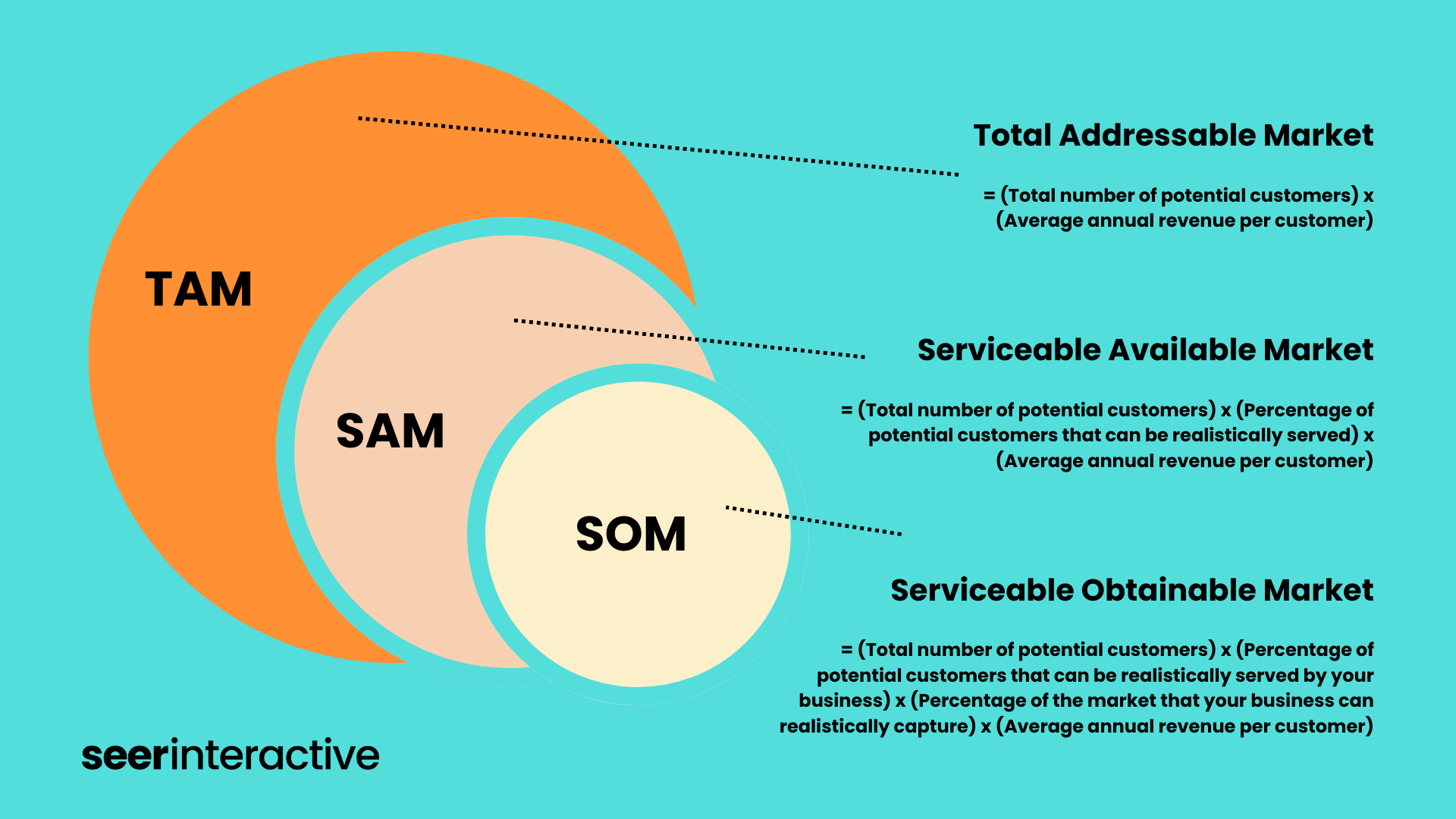
Graphic Source: Seer Interactive – Market Sizing with TAM SAM SOM
Why TAM Is So Important for Marketing Teams
TAM gives marketing teams clarity before they invest time or budget. It shows the true size of the opportunity. When you know your real market size, you make stronger, faster decisions.
TAM helps your team avoid wasted spend. Many businesses target broad audiences that never convert. TAM shows who actually belongs in your market. This clarity keeps your campaigns focused and effective.
TAM also helps you understand demand patterns. It shows which industries, buyer types, or regions offer real potential. This insight guides your segmentation and messaging.
TAM also supports better budget planning. Your team can map how much to invest based on the size of the opportunity. It removes guesswork and gives leadership a clear reason behind each decision.
This data keeps marketing and sales aligned. Both teams use the same numbers when choosing targets, forecasting revenue, or planning campaigns. This shared view reduces confusion and improves performance.
TAM even shapes your content plan. It helps you understand how much content you need and where to focus it. When your team knows the market size, it builds content that matches audience demand.
With TAM, your marketing team gets a strong foundation. Every decision becomes clearer, and every campaign becomes more strategic.
How TAM Becomes the First Step in Creating a Marketing Strategy
 TAM gives you the big picture before you build any marketing plan. It shows how large your opportunity is and where demand exists. When you understand this, you build your strategy with confidence instead of guesswork.
TAM also helps you see which markets matter most. Some segments offer more potential than others. This insight keeps your team focused on areas that actually drive revenue. It stops you from targeting groups that cannot grow your business.
TAM reveals gaps and patterns. You may find markets with strong demand and low competition. You may also spot crowded markets that need a different message or approach. These insights shape your future plans.
TAM also guides your channel choices. When you know who you want to reach, you pick channels that match their behavior. This alignment improves results and reduces wasted spend.
TAM becomes the bridge between raw data and smart planning. It gives your marketing strategist the information they need before creating the full strategy. They use the data to set goals, shape campaigns, and pick the right audiences.
A strong marketing strategy always begins with TAM. It sets the direction and keeps every decision grounded in real numbers.
What Data You Need to Build a TAM Report
A strong TAM report relies on accurate data. You need clear information about your customers, your market, and your pricing. When these pieces come together, you get a realistic view of your total opportunity.
Start with your customer demographics. Look at who buys from you today. Include details like age, role, industry, and company size. This information shows who fits your market.
Next, gather firmographic data. Firmographics include business type, revenue, employee count, and location. These numbers help you group your market into clear segments.
You also need geographic data. Define where your customers live or operate. This helps you remove regions you cannot serve.
Pricing data is important too. Your average deal value and annual revenue per customer help you calculate TAM. Accurate pricing creates accurate market estimates.
You also need sales data. Look at past customers, conversion rates, and common patterns. This information helps you build a bottom-up TAM model.
Competitor information can also help. It shows how crowded your market is and where the gaps are.
Finally, gather market size reports when available. Use them as a starting point, not the final answer. These reports can help cross-check your numbers.
With solid data, your TAM report becomes a reliable tool for planning and decision-making.
Who Should Produce TAM Data in Your Company?
 A strong TAM report often requires more than one team. No single department holds all the information. The best approach uses both finance and marketing working together.
Finance plays a key role. They understand revenue, pricing, and forecasting. They also know how to model data and check assumptions. Their work keeps your TAM numbers accurate and realistic.
Marketing brings a different set of insights. They understand buyer behavior, market trends, and audience demand. They know which segments respond well and which segments rarely convert. Their input keeps the TAM grounded in real customer behavior.
Sales can also support the process. They hear customer needs every day. They know which industries buy and which ones stall. Their observations add context to your data.
When these teams collaborate, your TAM becomes far stronger. Finance provides structure. Marketing provides insight. Sales provides real-world patterns. Together, they build a clear view of your true opportunity.
This shared process also improves alignment across your company. Everyone works from the same numbers. Everyone follows the same market map. This unity helps your teams move in the same direction.
How Often You Should Update Your TAM
Your TAM should not stay the same forever. Markets shift, pricing changes, and new competitors enter your space. Because of this, most companies update their TAM once each year. An annual update keeps your numbers accurate and useful.
Some companies update TAM more often. Update it sooner if you enter a new market or add a new service. Update it if your pricing changes or if your ideal customer shifts. These changes can affect your total opportunity in a big way.
You should also update TAM when customer behavior changes. New trends, new technology, or new regulations can reshape your market. A fresh TAM helps your team adjust before losing momentum.
Regular updates keep your marketing and sales plans aligned with real demand. They help your team avoid old assumptions and stay focused on the right segments.
A current TAM helps your business make stronger decisions. It also keeps your marketing strategy grounded in today’s market, not last year’s estimates.
Simple Examples of TAM for Different Industries
 TAM becomes easier to understand with simple examples. These examples show how different businesses calculate their total opportunity. Each example uses a basic formula: potential customers multiplied by average annual revenue per customer.
Example 1: A Software Company
A software company sells a tool to small businesses. They charge a yearly subscription. If 200,000 small businesses fit their criteria and each subscription averages $600 per year, their TAM is clear.
TAM = 200,000 × $600 = $120 million
This number shows the full potential if every qualified business became a customer.
Example 2: A Marketing Agency
A marketing agency serves mid-sized companies. They charge an average of $18,000 per year. If 5,000 companies match their ideal profile, the TAM becomes easy to see.
TAM = 5,000 × $18,000 = $90 million
This helps the agency understand the true size of its market before planning growth.
Example 3: A Local Service Business
A home services company operates in one city. If 40,000 homes fit their service area and the average yearly spend is $350, TAM is simple.
TAM = 40,000 × $350 = $14 million
This helps local businesses decide how much to invest in marketing and outreach.
Example 4: A B2B Manufacturer
A manufacturer sells industrial equipment to factories. If 8,000 factories use this type of equipment and each sale averages $25,000 per year, TAM becomes clear.
TAM = 8,000 × $25,000 = $200 million
This helps the company understand long-term potential and future demand.
Common Mistakes Businesses Make With TAM
Many businesses build their TAM too fast or with weak data. This leads to bad decisions and unclear goals. Avoiding common mistakes helps your team create a reliable and useful TAM.
Mistake 1: Using Outdated Industry Reports
Some companies rely only on old market studies. These reports often miss new trends or shifts. Using outdated data creates an inaccurate TAM.
Mistake 2: Confusing TAM With SAM
Many teams mix up TAM and SAM. They aim their campaigns at a smaller or larger group than intended. This confusion leads to wasted budget and weak results.
Mistake 3: Targeting Everyone Instead of the Right Segments
A large TAM does not mean every segment fits your business. When teams target too many groups, results drop fast.
Mistake 4: Ignoring Pricing Changes
If your pricing changes, your TAM changes. Many businesses forget this step and keep using old numbers.
Mistake 5: Not Grounding TAM in Real Sales Data
Some teams build TAM with high-level research alone. Without real customer data, the number becomes unrealistic.
Mistake 6: Never Updating the TAM
TAM changes as markets shift. Companies that never update their TAM operate with old assumptions.
Mistake 7: Treating TAM Like a Vanity Number
Some leaders treat TAM as a big number to impress people. TAM is a tool, not a trophy. It should guide decisions, not inflate expectations.
Avoiding these mistakes helps your team build a TAM that is accurate, helpful, and aligned with real-world demand.
Bringing It All Together
 Understanding your Total Addressable Market gives your team clarity and direction. It shows the full size of your opportunity and removes guesswork from your decisions. TAM helps you see where demand exists and which markets deserve focus.
TAM also supports better planning. It informs your targeting, your budget, and your expected growth. It keeps your team aligned and grounded in real numbers. With TAM, your marketing and sales efforts stay focused on the right audience.
TAM becomes the bridge to your future marketing strategy. It provides the data your strategist needs before building the full plan. If you want to learn how this data shapes your strategy, check out our guide on Marketing Strategists and how they turn TAM into actionable plans.
With a clear TAM, your business gains a strong foundation. Every choice becomes easier, and every campaign gains purpose. A well-built TAM gives your team the confidence to move forward with focus and direction.
Final Thoughts: Turning TAM Into a Clear Marketing Direction
TAM Gives You the Foundation You Need
TAM gives your business a clear view of the total opportunity. It shows where real demand exists and where your team should focus. With this clarity, you avoid wasted effort and build your plans with confidence.
A strong TAM gives every team a shared starting point. Marketing, sales, and leadership all work from the same numbers. This unity helps your business grow in a steady and predictable way.
Your Next Step Toward a Stronger Strategy
TAM is only the first step. It gives your marketing strategist the insights they need to plan your next move. When you understand your market size, you build smarter goals, stronger campaigns, and clearer messaging.
If you want to see how TAM connects to a full strategy, explore our guide on Marketing Strategists and how they turn data into growth.

About the Author
Jason Holicky is the founder of Holicky Corporation, a successful marketing agency in New Lenox, Illinois. With over 25 years of experience, he specializes in marketing consulting, website development, corporate photography, video editing, and social media management. Jason is passionate about helping businesses thrive, generate leads, and stay updated with current marketing methods and technology trends. He is a certified Google Ads expert and AppDirect technology advisor.
Related Posts




Ready to Elevate Your Online Presence? Let’s Get Started!
Take the first step towards a robust online website system with our expert web development services. Whether you’re looking to create a custom website, build a scalable Content Management System, or develop seamless APIs, our team is here to bring your vision to life. Contact us today to discuss your project and discover how our custom solutions can transform your online platform.